
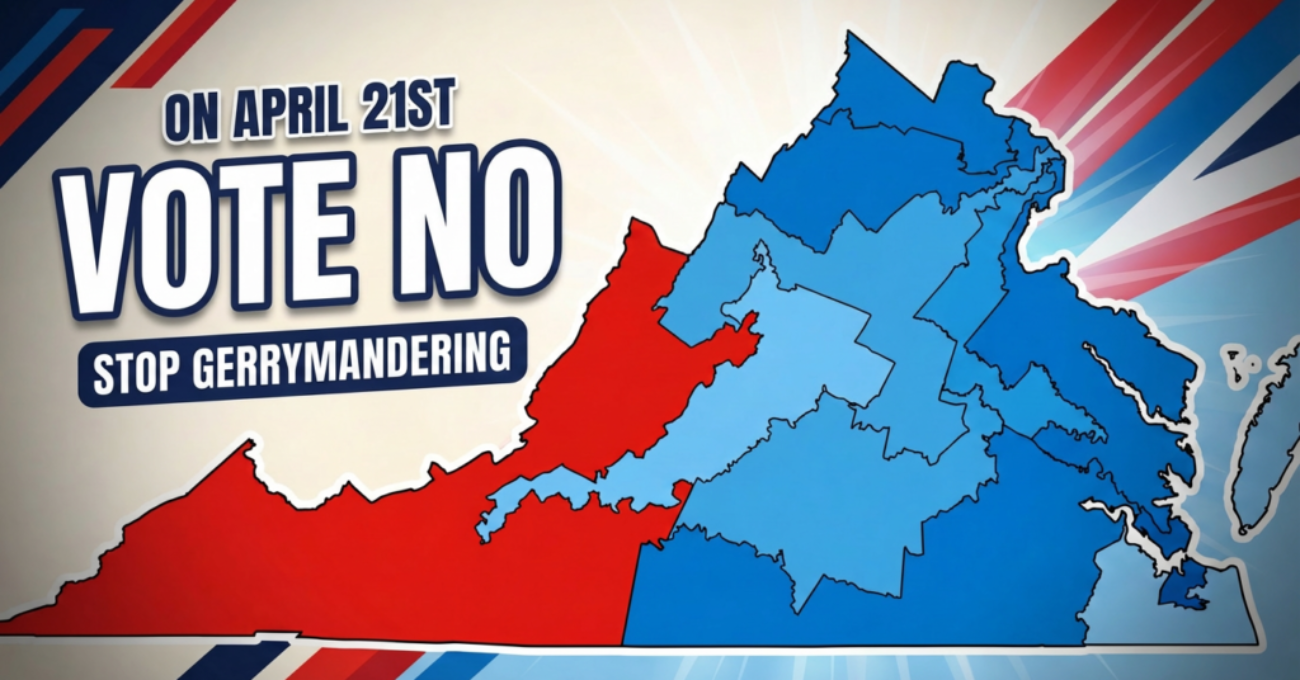
Why Virginians Should Vote NO
Protect Fair Representation and Stop Gerrymandering
On April 21, Virginians will face an important decision that could shape the state’s political landscape for years to come. At the heart of this vote is a question about how electoral districts are drawn—and ultimately, who holds power. While the details of redistricting can seem technical, the implications are anything but. This is about whether voters choose their representatives, or representatives choose their voters.
Gerrymandering is the practice of drawing electoral district lines in a way that benefits a particular political party or group. It often involves tactics known as “packing” and “cracking.” Packing concentrates opposing voters into a small number of districts to limit their influence elsewhere, while cracking spreads them across many districts so they can’t form a majority. The result is a map that may look fair on the surface but is carefully engineered to produce a predetermined political outcome.
Fair district maps are essential to a functioning democracy. When lines are drawn impartially, elections are competitive, and elected officials must remain responsive to the people they serve. But when maps are manipulated, competition declines, accountability weakens, and voters lose their voice.
The April 21 measure proposes changes to how Virginia handles redistricting. Supporters may argue that it streamlines the process or introduces reforms, but critics warn that it could open the door to increased partisan influence over how districts are drawn. That raises a serious concern: the potential for one party to lock in an advantage that lasts for years, even decades.
When gerrymandering takes hold, it creates “safe” districts where one party is virtually guaranteed to win. In these districts, elections become a formality rather than a meaningful choice. Politicians in safe seats have less incentive to listen to constituents, compromise, or work across the aisle. Over time, this erodes trust in government and discourages voter participation.
Perhaps most importantly, gerrymandering weakens the power of individual voters. Communities may be split apart or combined in unnatural ways, diluting shared interests and making it harder for residents to advocate for their needs. Instead of reflecting real communities, districts become political tools.
Other states offer cautionary examples. Where gerrymandering has been allowed to flourish, it has often led to long-term imbalances in representation, policies that don’t reflect the broader public will, and growing frustration among voters who feel their voices no longer matter. Virginia should take note and avoid heading down the same path.
Competitive elections are the backbone of a healthy democracy. They force candidates to engage with voters, address real concerns, and earn support. Fair maps encourage moderation, cooperation, and accountability. Without them, the system tilts away from the people and toward those in power.
Some may argue that both parties engage in gerrymandering, so it’s simply part of politics. But that’s exactly why stronger safeguards—not weaker ones—are needed. The goal should be a system that prioritizes fairness and transparency, regardless of which party is in control. This isn’t about benefiting one side over another; it’s about protecting the integrity of the process itself.
Voting NO on April 21 sends a clear message: Virginians value fair representation and want a redistricting process that serves the people, not political interests. It keeps the door open for reforms that emphasize transparency, balance, and accountability.
In the end, this vote is about more than lines on a map. It’s about the future of democracy in Virginia. When voters head to the polls, they have an opportunity to stand up for fair elections and ensure that their voices continue to matter.
A NO vote is a vote for a system where power remains in the hands of the people.