
August 21, 2026
Digital Dragnet: Target New River Valley
Surveillance cameras, geofencing, and data centers are quietly reshaping our community.
If you drive down Route 11, cross over the New River into Radford, or commute through Dublin and Pulaski every day, look up at the utility poles and intersections. You might think we live in a quiet, rural corner of Southwest Virginia where folks mind their own business and leave each other alone.
Think again.
Quietly, without real public debate or a ballot vote, our local streets and county lines are being wrapped in a permanent surveillance and infrastructure web. Between automated license plate readers tracking every vehicle trip, invisible digital geofences logging our phones, and massive data centers threatening to swallow our power grid and water supply, the New River Valley is being transformed into a high-tech dragnet.
Here is what is happening right in our backyard—and why every resident in Pulaski County and the City of Radford needs to wake up immediately.
1. Flock Cameras: Guilty Until Proven Innocent on Every Local Road
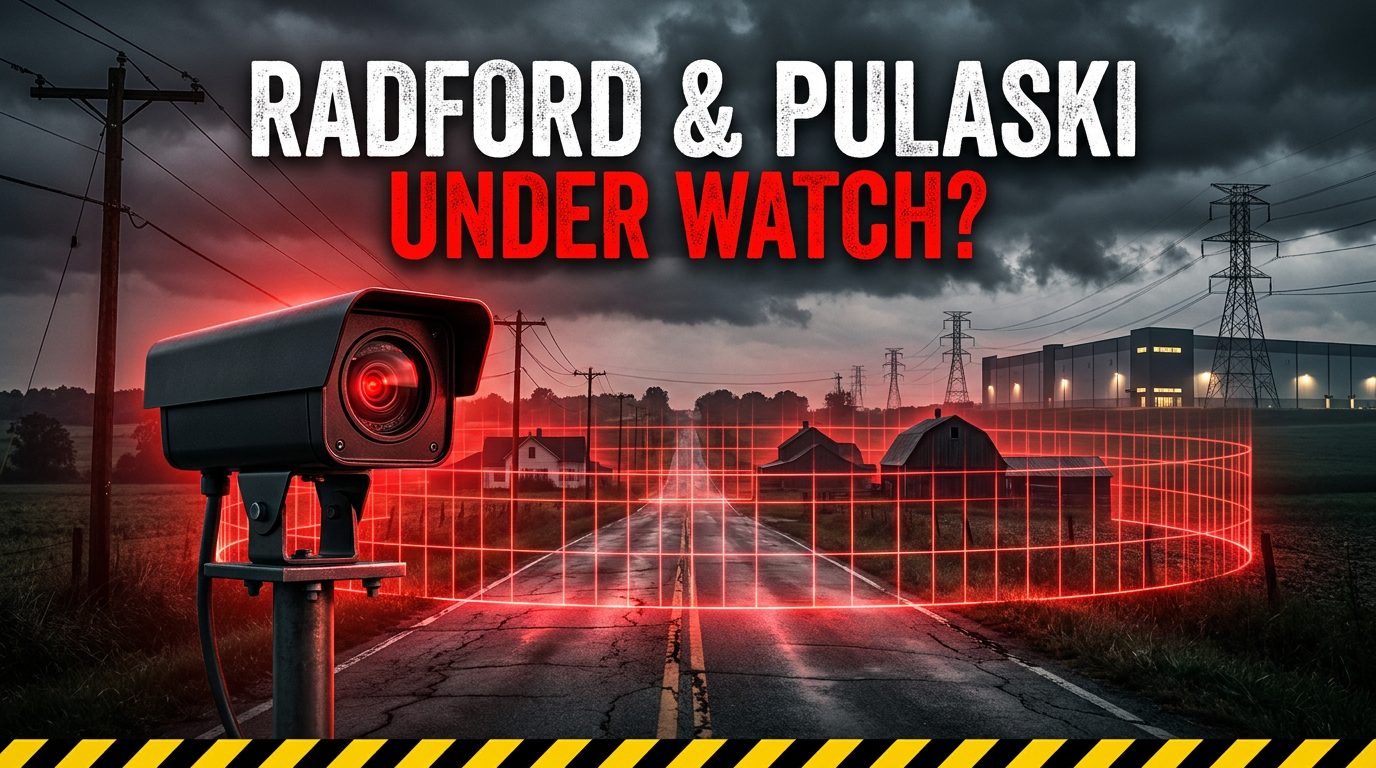
You've probably seen those sleek black cameras mounted on poles along major corridors. Those are Flock Safety Automated License Plate Readers (ALPRs).
They don't just snap photos of speeders or red-light runners. Flock cameras capture the license plate, make, model, color, bumper stickers, and unique markings of every single vehicle that passes by.
Think about what that means for your everyday life:
- •Every time you drop your kids off at school in Radford or Pulaski.
- •Every time you drive to church, visit a gun shop, stop at a pharmacy, or attend a political rally.
- •Every late-night run to the grocery store or visit to a friend's house.
Flock logs that timestamp and location into a centralized, searchable database. Even if you have never committed a crime in your life, your daily movements, habits, and routines are cataloged and stored. Worse, these private databases can be shared across hundreds of law enforcement agencies and third-party networks without a warrant. Why are law-abiding citizens being tracked like suspects just to drive through town?
2. Geofencing: The Invisible Fence Around Your Life
It's not just physical cameras watching our roads—it's the invisible perimeter around our phones.
Geofencing creates virtual boundaries around entire geographic areas. Using GPS, cellular towers, and mobile apps, data brokers and authorities can pull digital "reverse warrants" or bulk records on every device that entered a specific zone at a specific time.
Did you happen to be at a public protest, near a crime scene, or just sitting in traffic near a sensitive location? A geofence sweep can rope your phone, your identity, and your location history into an investigation simply because you were in the wrong place at the wrong time. We never consented to having our hometowns divided into digital paddocks where our presence is treated as corporate or government property.
3. Data Centers: Draining Our Power, Hiking Our Bills, and Thirsting for the New River
While cameras and digital networks gather trillions of data points on our lives, that data has to live somewhere: massive, power-hungry Data Centers.
Virginia is already the data center capital of the world, and Northern Virginia has run out of power and space. Tech conglomerates and utility developers are looking right at Southwest Virginia—specifically places like Pulaski County and the NRV—to build massive server complexes.
They sell these projects to local supervisors as "economic development," but here is the ugly truth they won't put on the brochure:
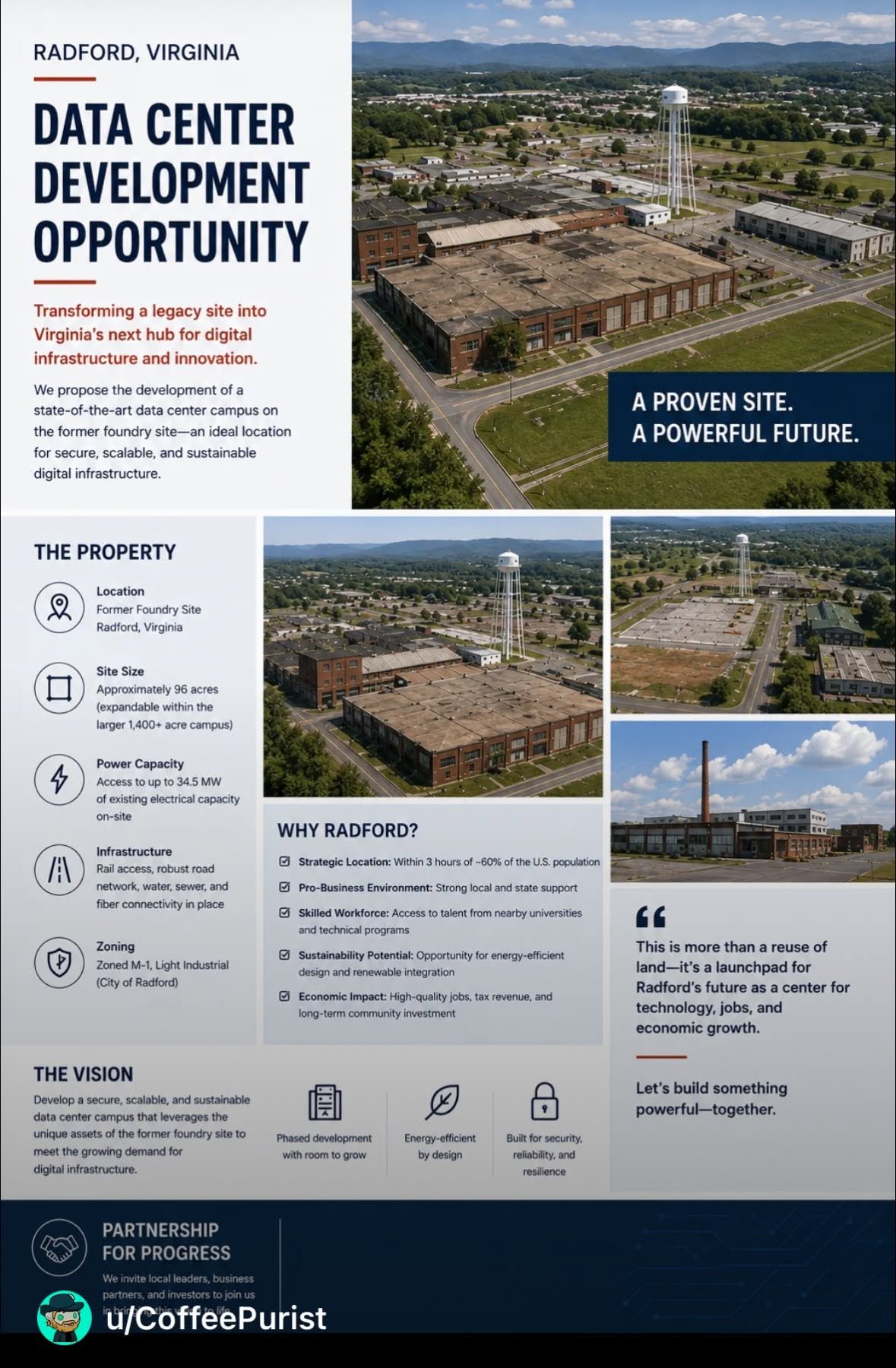
- •Your Electric Bill Will Spike: Data centers consume as much power as entire cities. When the grid gets strained, utility companies build new substations and transmission lines—and pass those multi-million-dollar capital costs directly onto local residential rate payers.
- •Millions of Gallons of Local Water: Cooling these warehouse-sized computer banks requires astronomical amounts of water every single day. Pulaski and Radford depend on the New River and local reservoirs; we cannot afford to deplete our clean water to cool corporate server farms.
- •Virtually Zero Long-Term Jobs: Once the concrete is poured, a massive data center might employ only a handful of security guards and technicians. We sacrifice hundreds of acres of farmland and open space for zero real community benefit.
The Big Picture: You Are Paying for Your Own Surveillance
When you connect the dots, the reality is chilling:
- •Flock cameras track your car.
- •Geofencing tracks your phone.
- •Data centers process and store your life while draining your local resources and hiking your monthly power bill.
Our local elected officials in the City of Radford and the Pulaski County Board of Supervisors are quietly letting this infrastructure take root without demanding binding public hearings, strict privacy ordinances, or transparent utility impact studies.
What You Must Do Right Now
We still have time to stop this before Southwest Virginia becomes another locked-down, high-tech surveillance corridor.
- •Call & Email Your Representatives: Demand that the Pulaski County Board of Supervisors and Radford City Council enact immediate bans or strict public oversight on ALPR cameras and geofence tracking.
- •Demand Data Center Moratoriums: Insist that any proposed data center or major power substation undergo mandatory, public water/power consumption audits before a single permit is issued.
- •Show Up at the Next Meeting: Pack the council chambers and board rooms. Look our officials in the eye and let them know: Our privacy is not for sale, and our community will not be monitored without consent.